
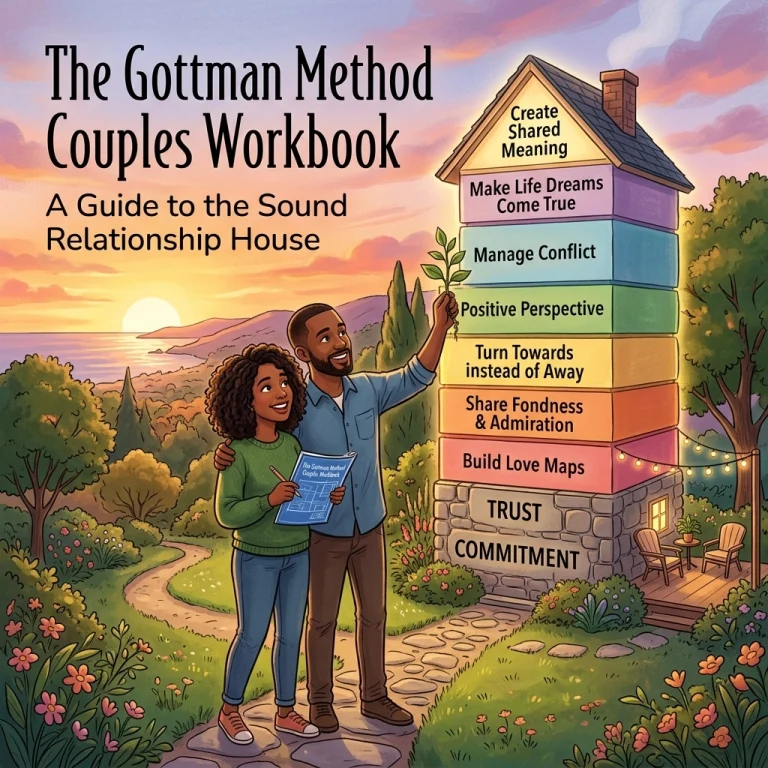
At the Gainesville Community Counseling Center, we believe that a truly flourishing relationship is not merely the absence of conflict, but the presence of a deep, enduring connection built on a foundation of mutual respect and understanding. When we look at the most successful couples, the “masters” of relationships, we see a structure that remains resilient even during life’s inevitable storms.
Dr. John Gottman’s decades of research led to the creation of the Sound Relationship House theory. This framework serves as a blueprint for long-term intimacy. Whether you are navigating a season of transition or simply wish to deepen your bond, this workbook is designed to guide you through the essential levels of a healthy partnership.
Part 1: Understanding Your Blueprint (Attachment Styles)
Before we build the house, we must understand the ground we stand on. Our attachment styles, formed in early childhood and refined by past experiences, influence how we seek proximity to our partners and how we react to perceived distance.
Your Turn: Attachment Style Self-Assessment
Read the following descriptions and reflect on which one resonates most with your typical behavior in your relationship.
- Secure: You feel comfortable with intimacy and do not often worry about being abandoned. You feel you can depend on your partner and they can depend on you.
- Anxious: You often worry that your partner doesn’t love you or won’t want to stay with you. You crave high levels of closeness and can become distressed when your partner is distant.
- Avoidant: You tend to feel “suffocated” when people get too close. You value your independence over intimacy and may withdraw during emotional moments.
- Disorganized: You feel a mix of desire for closeness and intense fear of it. Your reactions may feel unpredictable or confusing even to yourself.
Reflection Activity: Share with your partner: “I think I lean toward a [Style] because when I feel stressed, I tend to [Behavior]. How does this affect how you see me?” Understanding these patterns is the first step toward promoting healthy bonding.
Part 2: The Foundation – Love Maps
The first level of the Sound Relationship House is Build Love Maps. A Love Map is the part of your brain where you store all relevant information about your partner’s life, their favorite movies, their current stressors, and their deepest aspirations.
Your Turn: The Love Map Game
Set aside twenty minutes this evening. Ask each other the following questions. There is no right or wrong answer; the goal is simply to update your “map.”
- What is your partner’s greatest fear right now?
- Who is your partner’s best friend, and why?
- What is one thing your partner would do if they won the lottery tomorrow?
- What was your partner’s most embarrassing moment in childhood?
- What is your partner’s current favorite way to relax after a long day?

Part 3: Sharing Fondness and Admiration
In the Gottman Method, fondness and admiration are the antidotes to contempt. If you find yourselves focusing only on each other’s flaws, the “emotional bank account” begins to dwindle.
Your Turn: The Appreciation List
Take five minutes to write down three things you genuinely admire about your partner. Be specific. Instead of “You are kind,” try “I admired how patient you were with the waiter last night.”
Exercise: Read these lists aloud to each other. Notice how it feels to be seen and appreciated. This simple ritual acts as a protective shield against the wear and tear of daily life.
Part 4: Turning Towards Instead of Away
Every day, we make “bids” for connection. A bid can be a look, a touch, or a simple comment like, “Look at that beautiful bird.” You have three choices: turn towards, turn away, or turn against.
Your Turn: Identifying Bids
For the next 24 hours, pay close attention to your partner’s bids. When they speak to you, put down your phone, make eye contact, and acknowledge them.
- Instructions: Keep a tally of how many times you “Turn Towards” today. A simple “Mm-hmm, tell me more” counts as turning towards.
Part 5: The Positive Perspective
When the first three levels are strong, couples enter “Positive Sentiment Override.” This means you give each other the benefit of the doubt. You see a “grumpy” morning as a sign of a bad night’s sleep rather than a personal attack.
Your Turn: The 5:1 Ratio and Gratitude
The “Magic Ratio” is 5 positive interactions for every 1 negative interaction during conflict.
- Activity: Create a shared “Gratitude Jar” or digital note. Once a day, add one thing you are grateful for regarding your relationship. This trains your brain to scan the environment for the positive rather than the negative.
Part 6: Managing Conflict
Conflict is inevitable; it is an opportunity for growth. The goal is not to eliminate disagreement but to manage it with grace.
Your Turn: Softened Startup
How a conversation starts usually determines how it ends. Use a “Softened Startup” by following this formula:
“I feel [Emotion] about [Specific Situation], and I need [Positive Need].”
- Example: Instead of “You never do the dishes!” try “I feel overwhelmed when the kitchen is messy, and I’d really appreciate it if we could clear the counter tonight.”
The Aftermath of a Fight
If a conversation escalates into “flooding” (a state of physiological overwhelm), take a 20-minute break. Afterward, use the “Aftermath of a Fight” exercise:
- Feelings: Share how you felt without blaming.
- Realities: Acknowledge that two valid perspectives exist.
- Triggers: Discuss if any past wounds were poked.
- Responsibility: What part of the conflict do you own?
- Plans: How can we do it better next time?

Part 7: Making Life Dreams Come True
In a sophisticated partnership, each person acts as the “dream-catcher” for the other. When we feel stuck in a gridlocked conflict, there is often a hidden dream beneath the surface.
Your Turn: The Dream Within Conflict
Identify a recurring argument. Ask your partner: “Is there a deeper meaning or a dream behind your position on this issue?”
Listen without judgment. Supporting your partner’s life dreams: whether it’s starting a business or traveling the world: is essential for long-term vibrancy.
Part 8: Creating Shared Meaning
This is the “attic” of the Sound Relationship House. It’s about the culture you build together: your rituals, roles, and goals.
Your Turn: Rituals of Connection
Rituals are intentional ways of connecting that you can count on.
- Instruction: Choose one new ritual to implement this week. It could be a 10-minute “stress-reducing conversation” when you both get home, a Sunday morning coffee date, or a specific way you say goodbye in the morning.
Part 9: The Weight-Bearing Walls – Trust and Commitment
The entire house is held together by two pillars: Trust and Commitment.
Your Turn: The State of the Union Meeting
Schedule a weekly “State of the Union” meeting. This is a dedicated 30-60 minute block where you:
- Share what went well this week (Appreciation).
- Ask: “What do you need from me next week to feel more loved?”
- Process one issue or “skirmish” using the softened startup.
Your Turn: The Story of Us (Commitment)
Commitment is the choice to stay and cherish.
- Activity: Sit together and tell “The Story of Us.” How did you meet? What were your first impressions? What challenges have you overcome? Re-telling your shared history reinforces your “We-ness” and reminds you of the investment you have made in each other.

A Note on Professional Support
Building a Sound Relationship House is a lifelong project. It requires patience, vulnerability, and a willingness to learn. Sometimes, the foundation needs a professional eye to ensure it is level and secure.
At Gainesville Community Counseling Center, our experts are trained to help you navigate these levels with precision and compassion. If you find yourself struggling with gridlocked conflict or a sense of distance, we invite you to explore our expert counseling services.
Investing in your relationship is the most profound investment you can make in your overall well-being. Remember, there is no shame in seeking guidance; in fact, it is the hallmark of a couple committed to excellence and lasting love.
Your journey toward a more resilient, connected relationship starts with the very next “turn towards” you choose to make.